Thursday, 20 February 2014

German Theatre Experiences

In the past few weeks I've had the chance to experience two very different forms of German theatre. The first was a French tale told through puppets and speech, while the second was a retelling of the Grimm brothers' history, coincidently also relying heavily on the use of puppetry. I'll give a short summary of each experience, both were wonderful and challenging and something new for me! 

On Thursday the 30th of January I went along with Laura and Rhi to the PuK museum in Bad Kreuznach to experience puppet theatre for the first time. The theatre is located in the puppet museum in Bad Kreuznach which I vaguely remember visiting when I was here in 2006. The auditorium is small but was sold out for this first viewing and the stage offered the actors the chance to be both characters in the play as well as the main puppeteers. There were two actors, a man and a woman who served as the framework story. The woman became an Esmerelda parallel, selling her wares in the form of tourist souvenirs in front of Notre Dame in Paris. The Quasi Modo figure was then portrayed by a priest who came to her stall every morning to buy the newspaper without ever saying a word to her. At first this scenario appeared strange but then after the introduction the actors shifted roles and began expertly controlling a series of puppets across the stage to tell the Quasi Modo story in full. Below is Esmerelda and Quasi as they meet for the first time. The illusion of seeing the puppeteers and hearing their controlled voices didn't at first work, but then I realised that you have to focus on the puppets themselves and ignore what the humans are doing behind them. Once I'd figured that out, I began to appreciate the skilful control of their movements and just how realistic the =y appear when they move and express themselves. The destructive end of the framed narrative then foreshadowed the conclusion of the framing narrative and whether it was due to a lack of linguistic comprehension or just a general lack of comprehension, I was a bi baffled by the sudden jump to the 'real world' and the kiss which abruptly ended the play. I asked the German students we were with and there seemed to be a general confusion so I felt a bit better after that! All in all for my first full length puppet play, I was very impressed and enjoyed the experience! 
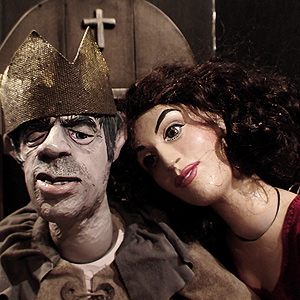
Notre Dame
On Thursday the 13th of February (clearly Thursday is the day to go to the theatre!) I saw a play called Grimm, das erste deutsche Maerchen: Ein Theaterprojekt von Jan-Christoph Gockel, roughly translated as Grimm, the first German fairytale, a theatre project. The theatre itself was wonderful; we were in the Kleines Haus of the Staatstheater Mainz and for the smaller of the two auditoriums it was a pretty decent size! We were very near the front, about 5 rows back and I was glad for the slight distance as the play turned out to be a little bit interactive! When we arrived the actors were already on the stage and as people were taking their seats they were running around the auditorium and taking unsuspecting audience members by surprise. The openness and willingness of the play to connect with the audience, allowed us to become much more involved in what was being portrayed which in a sense echoes the Grimm principle of involving us as individuals in something larger by way of comparison and moralising. Also from a language point of view it was rather useful as it helped to understand what was going on! Overall I think I understood around 70% of what was said, the rest was either spoken way too fast, or was in a local dialect or was in an accent too hard to understand when spoken quickly. There was one point when they were rolling around on the floor that I had no idea what was going on and felt completely lost! It came back, however, and overall I loved the performance as it made me much more curious about the lives of the Grimm family and I wanted to know much more than the confines of the play could tell me.

The structure allocated a fairytale to each member of the Grimm family (a mother and six children, 5 sons and one daughter) and as the story of their lives progressed interjections would be made and suddenly we were following the path of Red Riding Hood, Sleeping Beauty, Rumpelstilskin or Hansel and Gretel, all sufficiently dark and horrifying when in context of the Grimm family history. The play then moved on from the fairytales into the dictionary which was the first complied on such a scale in the German language. It was never published in its entirety in the brothers' lifetimes, taking up until well into the 20th century, circa Berlin Ball era, for all volumes to reach the shelves. This massive linguistic undertaking effectively killed off the Grimm brothers but what was clear in the play was that they never gave up on their imaginations and dared to dream that something so unthinkable as a record of every single word in the before broken up and divided German language, was not only achievable but was central to the continuation of the aim of bringing unity to a divided and disjointed culture. They sought to unite Germany under a sense of national heritage and cultural history in the form of their fairytales, taking well-known word of mouth stories and writing them down and then their dictionary continued this unification by adding the solidity of language to the fantasy of ideal.


This is taken from a wonderful scene in the play where the audience is looking at the house as it stands through the roof effectively and the actors are either standing or lying on their side to give the illusion that we are looking down on them. This demonstrated the wonderful construction to the play and added to the overall excitement. 

In terms of puppetry this clip and this image give you a sense of the play's use of smaller figures to demonstrate the whole and the building of the larger puppet figure became a parallel for the brining together of a nation in their "fairytale workshop". 


Overall I enjoyed both my theatre experiences and I intend to head back as soon as I can! 

Friday, 14 February 2014

Women in Society

To continue my more cultural related musings, this post is dedicated to the perception of women in German society. Like the smoking issue, this has been something which has slowly crept on me throughout my time living here and it only gets more noticeable the more I explore of the society around me.

Again this may be specific to my region, I don't know how far it stretches and if anyone has any experiences of other Bundeslaender in Germany it would be great to hear them!

For a society so advanced technologically as the Germans it seems strange that some aspects of their culture can be so traditional, especially in terms of gender roles. They have extremely set roles (again speaking generally of the average population, there are of course notable and wonderful exceptions) in terms of what the man and what the woman in a relationship, and in society as a whole, is responsible for. These crop up in a number of ways and result in many throwaway comments which aren't actually as women friendly as they pretend to be.

There are two main areas which I've noticed especially : children/childcare, and in the working world.

As far as my experiences have been, chatting with mothers here and working in two major schools in the town, the mother in a family is expected to not only give up her work in order to look after the children, but to then continue to not work until the children are past 14/15 years old in order to pick them up from school at 1pm. Even past that age they are expected to be home to cook the lunchtime meal which here is the main meal of the day. Outside the school gates at 12.30/1pm will be only mothers. School here finishes early and the younger ones can't go home on their own or cook for themselves and as it's the middle of the day and the father is working, it falls to the mother to fulfil that role.

Having spoken to women who do work, they said that they feel a lot of pressure from the society around them. Their choice to work has attracted negative attention as other mothers declare they are "bad" mothers for not dedicating 100% of their time to the children and consequently the children are viewed as worse off and disadvantaged. There is a thing called the "Ganztagsschule" here which is very similar to the school day that we have in Britain in that it lasts until 3-4pm with an hour for lunch in the middle. The children in this class are then open to being perceived in a negative light for not only having mothers who aren't able to pick them up at 1pm but also for not then receiving a main meal of the day cooked by their mother. Often this is bound to casual racism over the presence of children of foreigners whose culture is much more supportive of an active working mother and for whom it is more natural to have their child in school till the end of the day to allow them to return to work.

In professional environments too the 'glass ceiling' is more than evident and when asked to explain this phenomenon it's always related back to the role of the mother as principal child carer, stating that women can only reach so far up the career ladder before they decide to have children. When that happens they effectively can progress no further as they are reduced significantly in terms of hours they work and responsibility they are given. This isn't necessarily meant in a negative way at all, in fact in terms of accommodating a mother in the workplace Germany is fantastic and there is a lot of respect for the mother figure, it just appears to come at a cost. It's simply the expectation of the society that the mother will want to fulfil this preconceived role and it is this expectation which pressurises some women into following this path and giving up the life they were leading: career or family, very rarely both at the same time.

There is a prominent politician in Germany at the moment who used to be the Families minster and was promoted by Angela Merkel to Defence Minister not so long ago. Many have interpreted this move as an attempt to train her up as Merkel's successor and in terms of results she is efficient and a credit to the government. So far so good. If she has proven success in one cabinet position, why can't she be as successful in another more demanding role? When she was promoted there was outrage in the German press. The problem? She has 7 kids. Nothing more, just the fact she has children. Surely that shouldn't matter when accessing the capability of someone in a new role? As Families minister she was acceptable, because it was 'only' families (which in itself is an attitude which is problematic!) but defence minister apparently is a role too far for a woman with 7 children. I wouldn't have expected this from a country with a female Kanzlerin. But then Merkel has no children.

This kind of brings me on to the working world where these gender roles are much more subtly reinforced. In German society it is commonplace to get virtually all of your bread from the bakery every morning  and they are everywhere on every street. You will also only ever see women working there, cooking the bread on site and serving the customers. I once asked a German friend why and they said that it was because only women are deemed to be able to bake anything worth eating which was a compliment on their skills but does also assign the traditional stays at home and cooks for the family role. It is the same in the school canteen which is only run by women and almost every day I am reminded that they are mothers of children at the school, therefore it's ok for them to work there in the kitchen and it's ok for me to eat there.

Cleaning is also another profession which is more than predominantly women and whilst that may also be the case in England you will see male cleaners or janitors in school in the same way female engineers, plumbers or craftsmen exist. Here the roles are distinctly separate with much more prejudice and less acceptance of a woman wanting to train in these practical courses.

I don't really know what conclusions to draw from my experiences. I am naturally drawn to interpreting these instances as being restrictive of women in  society, if not in practical execution at least in perpetuating negative stereotypes and creating an atmosphere of pressure and expectation. However, I do understand how they can be seen as supportive of women, particularly mothers in allowing them and giving them room to be with their children and care for them. It just surprised me how traditional the attitudes remain in such a forward society, especially in comparison to the extreme consciousness of British society to gender equality, which doesn't appear to be a topic here at all, or at least nowhere near on the same level.

This is also based on my own experiences and what I've personally seen and heard which in terms of the scale of the whole of Germany renders little exposure and like I said above could be unique to this area or my particular situation. I hope I haven't offended anyone, that certainly wasn't my intention and if anyone has any experiences they'd like to share then please do comment underneath, thank you!


Monday, 3 February 2014

Put That In Your Pipe and Smoke It!

Anyone currently living on the continent will be experiencing this phenomenon and it's something which makes me kind of glad to live in Britain, even with its ridiculous Nanny State laws.

Smoking.

In principal I have no problem with it, so long as those who choose not to smoke are not affected. This appears to be the line that countries like Britain and New Zealand have taken in banning smoking "in enclosed or substantially enclosed public or work places" since July 2007. This prevents non-smokers from experiencing the dangers of passive smoking and retains their element of choice over the whole situation. The Germans and Austrians have other ideas, however, and it wasn't until living here that I actually began to seriously notice the difference.

In basic day to day life, smoking here takes a much higher place in normal public activity. Everywhere you go it can be as much as every other person who has lit up and is smoking their way down the high street, into a restaurant, in a taxi or at a football game. And when the street happens to be empty of real life smokers, posters and adverts everywhere are promoting the tar enriched products at reduced prices through images of beautiful looking women and perfect happy couples.

Here this seems completely normal and what really gets me is the number of people smoking around very young, or young, children. Mothers pushing prams will stop, light up, and then grab the hand of their toddlers before continuing, pram and cigarette in one hand and child in the other. It's been a long time since I've seen that in Britain and certainly not as often as I see it here.

Amongst students too there is a growing smoking epidemic and no wonder. The constant exposure to advertising and the ease of purchase makes them easy prey for the tobacco companies who recognise this growing sector as a massive profit margin. Playing with lives to make money. There are cigarette machines on many streets and at the supermarket the tobacco and cigarette sections are right by the till, all you have to do is push the button of your desired brand and it drops right onto the belt ready to be paid for and I have never seen an ID been shown, or any questions asked. Ok at the machines outside you need to swipe a valid 16+ ID card but with no one there to control or oversee the machines all it takes is one friend over 16 or one fake ID and you can get your hands on as many cigarettes as you like.

I guess it's only because I am a non-smoker that I notice these things as after sitting in a smoke filled restaurant or cafe, I notice the smell on my clothes and in my hair for days afterwards even after washing. Or even when my 11. or 12. Klasse arrive for my lesson I can smell it on their clothes as they walk past to their seats.

The tide is changing, however, and now most restaurants for example will either out-rightly declare they are non-smoking or they will at least sit the smokers together, away from the rest of the room as was normal pre
2007 in the UK. But the figures are still high. Germany has one of the highest numbers of smokers in all of Europe with the number of cigarettes smoked per adult per year (average) standing at 1,045 compared to Britain's 750. These vending machines I mentioned earlier are also demonstrative of the phenomenon as Germany has the highest number of cigarette vending machines per capita with 800,000 per 82 million people. In a comparative survey of medical students in Goettingen and London, it was found that around 23% of the German medical students smoked compared to the 10% ratio of London medical students.

This is one of those things that moving to another country teaches you. It's not something you're going to read in a guide book or even a text book but it's evidently a much bigger part of their culture out here and probably says more about the hyper-sensitive and over-protective Britain than it does about the more relaxed Europeans. For my part, it's an aspect of the culture here which baffles me as for a nation so obsessed with their health and good living, to be so dependent on things which are not only expensive but have serious medical drawbacks, feels a little non-compliant and will probably remain so until I leave in June.